

Open the official Tower Rush demo
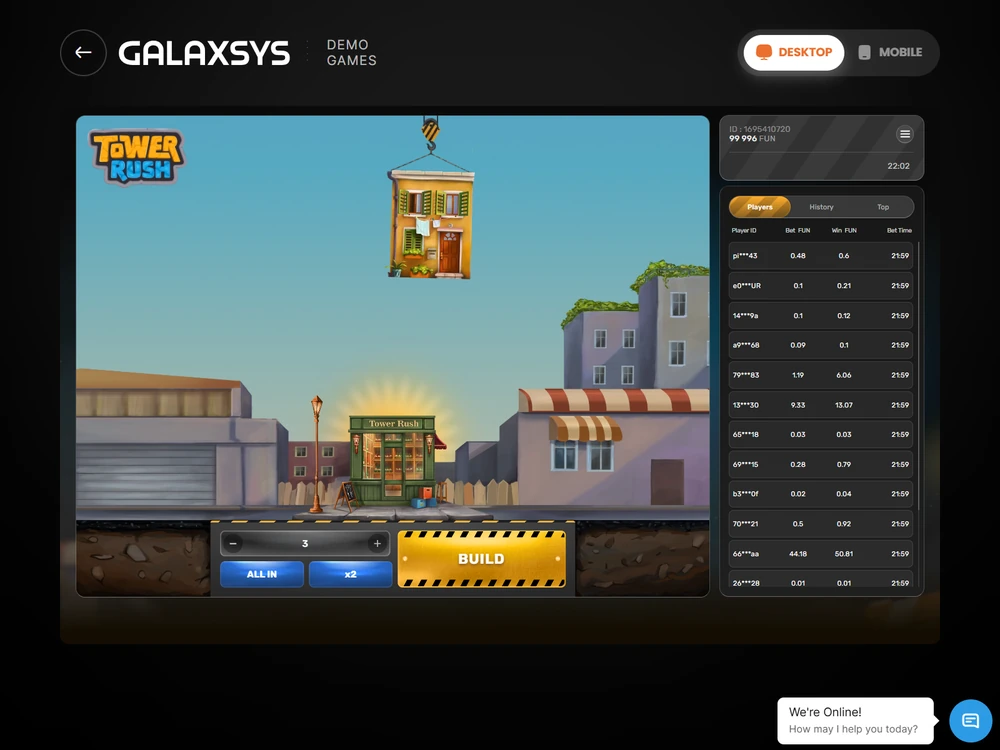
Open the official demo, wait for the game to load and check that the balance is labelled FUN before choosing a stake. This identifies the virtual mode; a familiar tower graphic alone does not tell you whether an operator has opened a demo or a funded account.
When a “tower rush demo” search leads you to similarly named titles, select the original Galaxsys product: Tower Rush 2 and Tower Rush Branded are separate games, and the number in this publisher's domain does not change the subject.
Start on desktop
The desktop route uses the provider's own game frame with an English interface, whose language setting is separate from the surrounding article and therefore does not change simply because you select another website language.
- Open the demo and wait for the FUN balance and controls.
- Select Rules to read the round controls and payout limit.
- Set an amount within the displayed stake range.
- Press Build and wait for the server to accept the action and return the floor result.
- After a successful floor, choose Cashout or another Build.
Use the mobile route
Galaxsys provides a separate mobile demo route. Mobile access is covered on Google Pixel 10a with Android 16 and iPhone 16 with iOS 26.5; the phone route remains distinct from the desktop frame.
For readers in Pakistan, opening FUN mode does not require funding a PKR wallet, while opening a real-money game through an operator involves that operator's account and access conditions. The mobile access guide covers those wider routes.
Read the stake, controls and round state
Build starts or continues your individual round; Cashout settles the accumulated payout after a successful floor.
There is one stake panel and one initial stake debit. A later Build within the same round continues the existing stake. It does not charge that initial amount again. A new round begins only after the previous cycle closes.
Select the amount before the round
For “tower rush game demo” access, the selected original profile uses stakes from 1 to 100 FUN in 0.50 FUN increments; check your amount before pressing Build because a change for the next round does not rewrite an accepted stake.
The interface includes amount controls, x2 and All In. Treat these as ways of changing the selected amount. They do not improve the chance of a successful floor, remove the payout cap or make the next action automatic. The chosen amount still has to fit the active profile's limits.
A below-minimum request can be rejected before acceptance without a debit. Insufficient balance can also prevent a new stake. Neither condition is a settled losing round, and repeatedly pressing Build is not a useful way to distinguish rejection from a delayed response.
Follow the accepted result
Server acceptance separates a requested action from an accepted round, with the green acceptance notice, falling-floor x0 and OOPS! displays helping you follow the interface while the settled history and balance establish the debit and payout.
After a successful placement, the next floor coefficient applies to the accumulated amount. Cashout credits the accepted gross payout and returns the game to its starting state. If the floor falls, the round loses its unprotected value; Frozen protection has its own rule explained below.
Sound changes the presentation. Rules explains the game. Players, History and Top expose different views of activity. A player-feed payout is not your account balance, and a FUN amount in that feed is not evidence of money arriving in a bank or mobile wallet.
Keep Net Position, the balance change for the displayed session, separate from the amount currently offered by Cashout for the live round; adding the two displays would mix session movement with a payout that has its own settlement state.
Learn the three bonus floors
Frozen Floor, Temple Floor and Triple Build affect an accepted round differently, with each bonus type revealed only after successful placement rather than disclosed by the ordinary appearance of the incoming floor.
Frozen protects an amount once
Frozen Floor fixes an amount that survives a later fall and remains included in any larger final payout you take after successful continuation, so the game does not credit the protection a second time on top of that larger total.
In one of my rounds, a 12.50 FUN stake reached a protected 31.25 FUN and then fell, paying that protected amount and leaving 18.75 FUN profit after the original stake; the protection applied to this round alone.
I also recorded an 11.00 FUN round with 27.50 FUN protected, followed by a successful continuation and a 68.75 FUN Cashout. The final profit was 57.75 FUN. Adding the protection again would incorrectly turn the payout into 96.25 FUN.
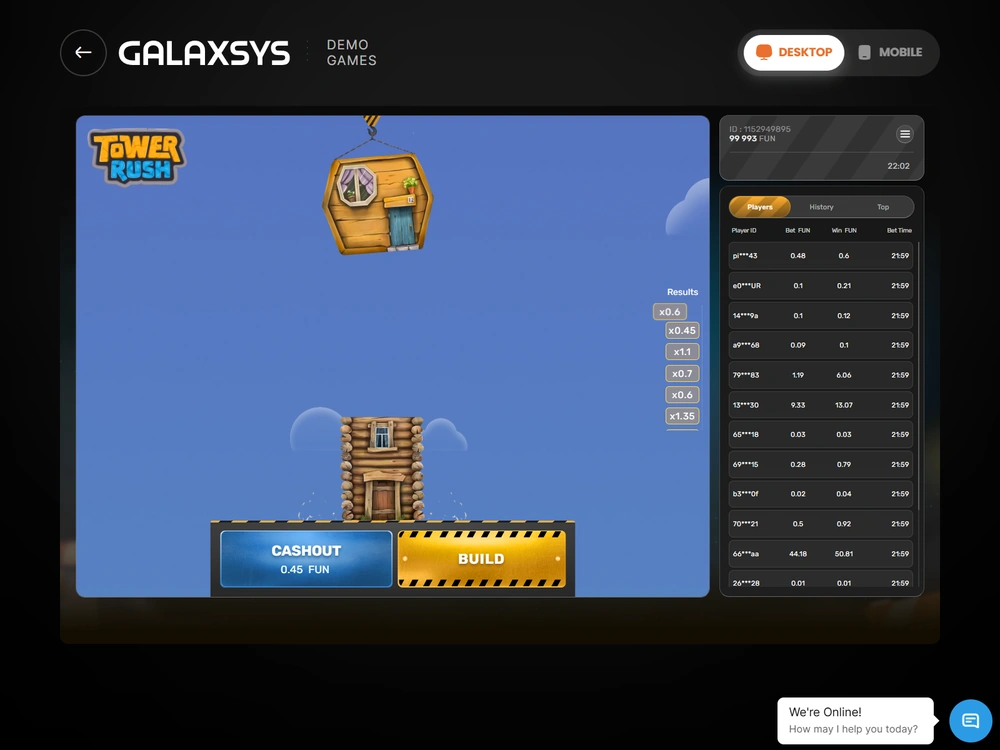
Frozen can occur only once within a round. No further bonus floors appear after it, and a subsequent successful floor in that state has a multiplier of at least 1.5×. A fall remains possible, with the protected amount governing the resulting payout.
Temple and Triple use the accumulated value
Temple Floor spins a wheel whose result multiplies the current accumulated amount. Its ten sectors are 1.5×, 1.5×, 2×, 2×, 3×, 3×, 5×, 5×, 7× and Frozen. Repeated labels do not, by themselves, establish the probability of each result.
My 8.50 FUN Temple example reached 1.8× the stake before a 2× sector, producing 30.60 FUN gross. That is 8.50 × 1.8 × 2, rather than an instruction to multiply only the original stake by the wheel result.
Triple Build adds three floors without three new stake debits: in my 16.00 FUN example, coefficients of 1.2×, 1.25× and 2× produced 48.00 FUN gross from one initial debit, giving 32.00 FUN profit.
Neither feature is Buy Bonus. The selected original profile also has no slot reels, paylines, wilds, scatters or separate jackpot; those familiar slot concepts would describe a different game structure. Use the round rules for the complete sequence.
My FUN session, from the first stake to reset
I played a 27-minute FUN session on Google Pixel 10a with Android 16, taking a 2,200.00 FUN opening balance to 2,489.00 FUN over 25 accepted cycles comprising 24 settled game rounds and one refunded technical void.
Concrete outcomes and the payout convention
Gross is the full game payout, including any returned stake component. Net subtracts the stake. A positive payout can therefore leave a round at break-even. A refund belongs in its own category because it reverses a debit instead of recording game winnings.
| Event | Stake FUN | Gross or refund FUN | Net FUN | What happened |
|---|---|---|---|---|
| Manual Cashout | 6.00 | 10.80 gross | 4.80 | Accepted 1.8× exit |
| Temple Floor | 8.50 | 30.60 gross | 22.10 | Accumulated 1.8×, then a 2× sector |
| Frozen, then a fall | 12.50 | 31.25 gross | 18.75 | Protected amount paid |
| Triple Build | 16.00 | 48.00 gross | 32.00 | One debit, three floor coefficients |
| Return from the background | 21.00 | 37.80 gross | 16.80 | The existing round settled once |
| Frozen, then Cashout | 11.00 | 68.75 gross | 57.75 | Protection included in the final total |
| Technical void | 18.00 | 18.00 refund | 0.00 | Initial stake returned, no game gross |
The 6.00 FUN manual exit illustrates the basic calculation. The balance first loses the stake, then receives 10.80 FUN. The improvement over the pre-round balance is therefore 4.80 FUN, not the full amount printed beside Cashout.
Two settled rounds returned exactly their stakes. Five settled rounds returned no gross payout. The remaining seventeen were profitable. Counting every payout as a profitable result would hide those break-even outcomes and overstate the session's successful-round rate.
Totals and the limits of a short sample
After removing the 18.00 FUN void stake that had been included in the initial debits and subsequently returned, my session's comparable turnover was 363.00 FUN against 652.00 FUN in game payouts.
| Measure | Result | Interpretation |
|---|---|---|
| Accepted cycles | 25 | Includes one void |
| Settled game rounds | 24 | Denominator for outcome frequencies |
| Initial debits | 381.00 FUN | Includes the cancelled stake |
| Void refund | 18.00 FUN | Cancels that stake's debit |
| Settled turnover | 363.00 FUN | 381.00 minus 18.00 |
| Game gross | 652.00 FUN | Refund excluded |
| Net result | +289.00 FUN | Gross minus settled turnover |
| Final balance | 2,489.00 FUN | Starting balance plus net result |
| Observed return | 179.614325% | Total gross divided by turnover |
| Rounds with positive gross | 19/24, or 79.1667% | Includes two stake-only returns |
| Profitable rounds | 17/24, or 70.8333% | Gross exceeded stake |
| Bonus events | 4/24 | Two Frozen, one Temple, one Triple |
| Largest observed payout | 68.75 FUN | A session result, not the game cap |
| Maximum drawdown | 61.50 FUN | Largest balance decline from a prior peak |
| Longest run without gross | 3 rounds | An observed sequence, not a forecast |
The balance reconciles as 2,200.00 − 363.00 + 652.00 = 2,489.00 FUN. The void debit and refund cancel. No obligation remained unsettled. There is consequently no pending stake or expected credit hidden outside this closing balance.
The configured RTP for this demo profile is 97%; the observed 179.614325% is a different measure. On a fixed 363.00 FUN turnover, the RTP expectation is 352.11 FUN gross and −10.89 FUN net. A short session can finish far above or below that expectation.
Stakes differed between rounds, which also makes the unweighted average gross-to-stake ratio, 1.935417, different from total gross divided by total stakes. Each answers a distinct question: the former weights rounds equally, whereas the latter measures the return on the actual turnover.
The net-result sample variance was 421.548406 FUN² using a denominator of 23, and the standard deviation was 20.531644 FUN. These figures describe the spread of this small set of settled outcomes; they do not supply the probability of a particular future floor.
For the 19 positive-gross rounds out of 24, the Wilson 95% interval is 59.5295%–90.7552%. Its width reinforces the sample limitation. It is not a promised payout rate for your session. It does not identify a profitable target. It cannot turn the player feed into a prediction tool.
A fresh session resets virtual funds
Starting a new demo session reset my balance from 2,489.00 to 2,200.00 FUN through a −289.00 FUN adjustment that removed the preceding session's net gain without recording another losing round.
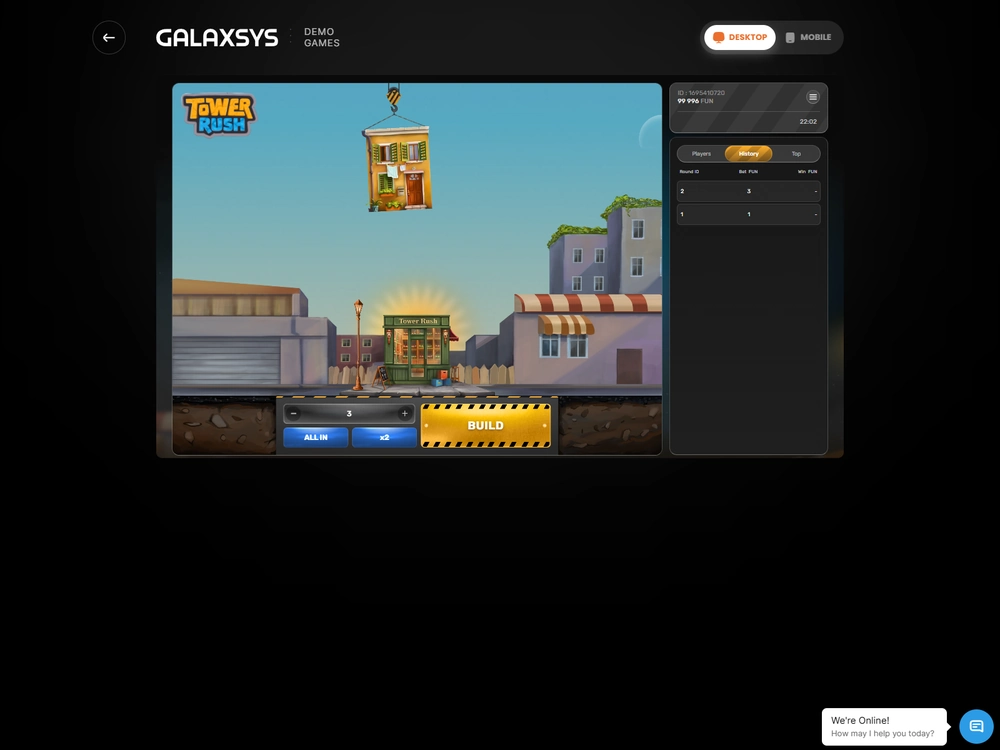
Because the provider's other demo presentation can start at 100,000 FUN, keep each session's opening amount, wagers and closing amount together when checking its arithmetic instead of assuming every screen begins at my test balance.
A separate provider display moved from 100,000 to 99,680 FUN with Net Position −320, illustrating how the field describes that session without making those figures part of my different 2,200 FUN journal.
Demo and PKR play have separate balances
FUN remains virtual even after a profitable session. Monetary play requires an operator account. You select the cash mode there. Practice credits do not become a deposit, a bonus entitlement or a withdrawal request during that change of route.
| Setting | Selected FUN demo | Selected PKR configuration |
|---|---|---|
| Unit | Virtual FUN | PKR in an operator account |
| Configured RTP | 97% | 97% |
| Stake range | 1–100 FUN | 27.00–36,000.00 PKR |
| Stake increment | 0.50 FUN | 0.50 PKR |
| Gross cap per round | 10,000 FUN | 3,150,000.00 PKR |
| Cashout destination | Demo balance | Game balance within the operator account |
| External withdrawal | FUN cannot be withdrawn | Separate operator cashier process |
Both selected profiles have a 97% RTP, yet they remain separate configurations with different units and limits. The same percentage does not establish identical settings across every operator, and a 10,000 FUN payout limit must not be relabelled as a universal 100× maximum.
The game rules also distinguish Free Bet, a specified number of bonus bets, from Free Amount, a bonus balance. A rules example of ten 100 FUN bets is not an automatic offer to every demo visitor. Activate an applicable reward before using it, and disable an active Free Bet or Free Amount before playing with real funds as required by those rules.
Ordinary FUN credits are not an operator welcome bonus. The selected welcome offers across the ten operator profiles give Tower Rush a 0% wagering contribution, so playing this game does not advance those offers' wagering requirements. The real-money guide explains the separate cash journey.
Deal with interruptions and the payout cap
An interrupted animation does not determine an accepted round's financial result, because the server controls the outcome while a slow connection or device can delay the display without turning a pending state into a confirmed loss.
When I returned from the background during the 21.00 FUN example, the existing round produced one 37.80 FUN settlement. I could read that result again. It did not create another stake. Nor did it add another credit. Check history and balance before treating a delayed response as a new round.
Under the provider rules, a connection that fails to return for an hour after acceptance leads to the round ending after that inactivity period, with the registered win credited.
A game-equipment or software malfunction has a different outcome: affected bets and payouts are voided and stakes returned.
The payout ceiling also needs its own interpretation. A calculation reaching 12,875 FUN is capped at 10,000 FUN, leaving 2,875 FUN above the ceiling unpaid. Continuing cannot increase the payout beyond that limit and may expose the accumulated amount to a loss. The cap does not add an Auto Cashout feature.
Use practice to understand the controls
Use the demo to follow one accepted stake through Build, a floor result and settlement, then inspect how gross, profit, protection and reset affect the balance. That knowledge helps you read the game; it does not make FUN withdrawable or predict the next outcome.
Open the official FUN demo to explore those controls, or read the step-by-step rules before your next round.
Tower Rush Demo Controls and Your FUN Balance
FAQ
Do I need to deposit to use the Tower Rush demo?
No. The official FUN route needs neither a deposit nor a cash account. An operator may have its own entry requirements, but that does not make a payment necessary for the provider's virtual demo.
Can I withdraw the FUN balance?
No. FUN has no monetary withdrawal value and cannot be transferred into a PKR deposit. Cashout settles a demo round to its virtual balance; an external cash withdrawal is a different operator process.
What are the demo stake limits?
The selected profile accepts 1–100 FUN in 0.50 FUN increments, with a 10,000 FUN gross cap per round. Check the active game's displayed settings rather than borrowing monetary limits from another configuration.
Why did my demo balance reset?
A new session receives a fresh virtual balance. My recorded reset changed 2,489.00 to 2,200.00 FUN, a −289.00 FUN adjustment rather than a round loss. Other demo presentations can use a different starting amount.
Does the demo have Auto Cashout?
No. The selected original Tower Rush profile has neither Auto Cashout nor Autoplay. Build and Cashout are manual choices; the payout ceiling is not an automatic-exit setting.
Does a profitable demo session predict cash results?
No. My 179.614325% observed return came from 24 settled FUN rounds and is separate from the profile's 97% RTP. A short practice result does not establish a future return or guarantee a profitable monetary session.

Abid Bilawal
Author: Abid Bilawal
Role: iGaming, betting and gambling expert
Experience: 10+ years analysing online casinos, game providers, games and payment systems
Published: November 6, 2026
Device: Google Pixel 10a / Android 16 / Pixel UI
Additional device: iPhone 16 / iOS 26.5
Methodology: Methodology
Publisher and licensing
Tower Rush Pakistan is an informational publisher about the original Tower Rush by Galaxsys. The publisher does not accept bets, hold operator funds, create casino accounts or promise returns. The game provider, casino operators and publisher are separate entities. Third-party trademarks belong to their respective owners.
Responsible gambling
Play responsibly. Gambling involves financial and personal risks. Set your limits. Need help? Contact GamCare or visit GambleAware. 18+.