


What is tested and who performs the work
Abid Bilawal is the author and tester, with more than ten years spent analysing gambling products, online casinos, game providers and payment systems; his main test handset pairs Google Pixel 10a hardware with Android 16 and Pixel UI.
The original Tower Rush is supplied by Galaxsys, whose game rules define its mechanics; operator terms govern your account, cashier and welcome offer. The publisher, Tower Rush Pakistan, handles information about the game and never accepts bets. Its contact form concerns the guide rather than your casino account.
Evidence is matched to the claim: provider rules establish configuration, direct tests establish what happened in a particular account or device route, and third-party commentary remains attributed opinion or community feedback rather than a test performed by Abid.
Measured launches and sample boundaries
A launch measurement starts when the exact game card is selected and ends when Build becomes active. I measured that interval separately for cold and warm starts on Android and iPhone. Installing the app and opening the operator shell are outside the interval.
| Device route | Cache state | Attempts | Measurement boundary |
|---|---|---|---|
| Pixel 10a, Android 16 | Cold, data cleared | 7 | Game-card selection to active Build |
| Pixel 10a, Android 16 | Warm, cache retained | 7 | Game-card selection to active Build |
| iPhone 16, iOS 26.5 | Cold, data cleared | 7 | Game-card selection to active Build |
| iPhone 16, iOS 26.5 | Warm, cache retained | 7 | Game-card selection to active Build |
Ten operator profiles, each with four series, produce 280 ordinary launches and zero ordinary launch errors. Deliberate connection interruptions and desktop checks each remain separate, since combining those conditions would change the meaning of the success-rate denominator.
The Pakistan home Wi-Fi profile measures download throughput of 91.7 Mbps and upload throughput of 31.4 Mbps; a separate recovery scenario switches to mobile data, while the launch clock measures the entire card-to-Build interval rather than connection throughput alone.
Android tests use operator WebView containers, with Chrome 156 as the comparison browser; the iPhone uses WebKit, with Safari 26.5 for browser comparison. The desktop environment is Windows 11 x64 with Chrome 156.0.8078.80 and a 1,536 × 960 CSS-pixel window.
Portrait and landscape windows are 412 × 924 and 924 × 412 CSS pixels on Android, and 393 × 852 and 852 × 393 on iPhone. Brightness is 55%. These are scenario settings. CSS window dimensions do not describe the physical screen's pixel resolution.
For example, my seven 1Win Android cold starts took 4.360, 5.010, 6.830, 5.140, 4.360, 3.450 and 3.060 seconds, yielding a 4.6014-second mean, a 4.360-second median and a 3.060–6.830-second range rather than a single selected best result.
The Android warm mean is 1.2750 seconds, paired with a 1.365-second median; on iPhone, the cold mean and median are 5.5900 and 6.330 seconds, while the warm equivalents are 1.8843 and 2.010 seconds. These are four separate seven-attempt series, not one pooled device average.
How rounds and transactions are counted
Each event is counted by its accepted state and final settlement, with separate records for the stake, gross game payment, refund, bonus adjustment and external transfer; neither a screen refresh nor a return to the app creates another financial event.
Settled rounds, refunds and returns
My demo session contained 25 accepted cycles, comprising 24 settled rounds and one void. From 381.00 FUN of initial debits, the void returned 18.00 FUN; removing that stake leaves 363.00 FUN of comparable turnover against 652.00 FUN of full game payouts.
The reconciliation is 652.00 − 363.00 = 289.00 FUN net, matching the increase from a 2,200.00 FUN opening balance to a 2,489.00 FUN closing balance; resetting a new demo to 2,200.00 FUN is a separate −289.00 FUN adjustment, not another gambling loss. No FUN remained unsettled at the end of the session.
Observed return is total gross payouts divided by comparable turnover: 652 ÷ 363 × 100 = 179.614325%. This is the return of that short sample. It does not replace the 97% RTP configuration. Demo FUN also remains distinct from a PKR deposit or withdrawable account balance.
The average individual gross-to-stake ratio is 1.935417. It gives each settled round equal weight, even when the stakes differ, whereas the ratio of total payouts to total stakes weights the result by turnover. Check the denominator before comparing returns.
There were 19 positive gross payments among 24 settled rounds, or 79.1667%. Only 17 rounds were profitable, or 70.8333%. Two returned exactly the stake. Calling every positive payment a profitable round would erase that distinction and inflate the apparent win rate.
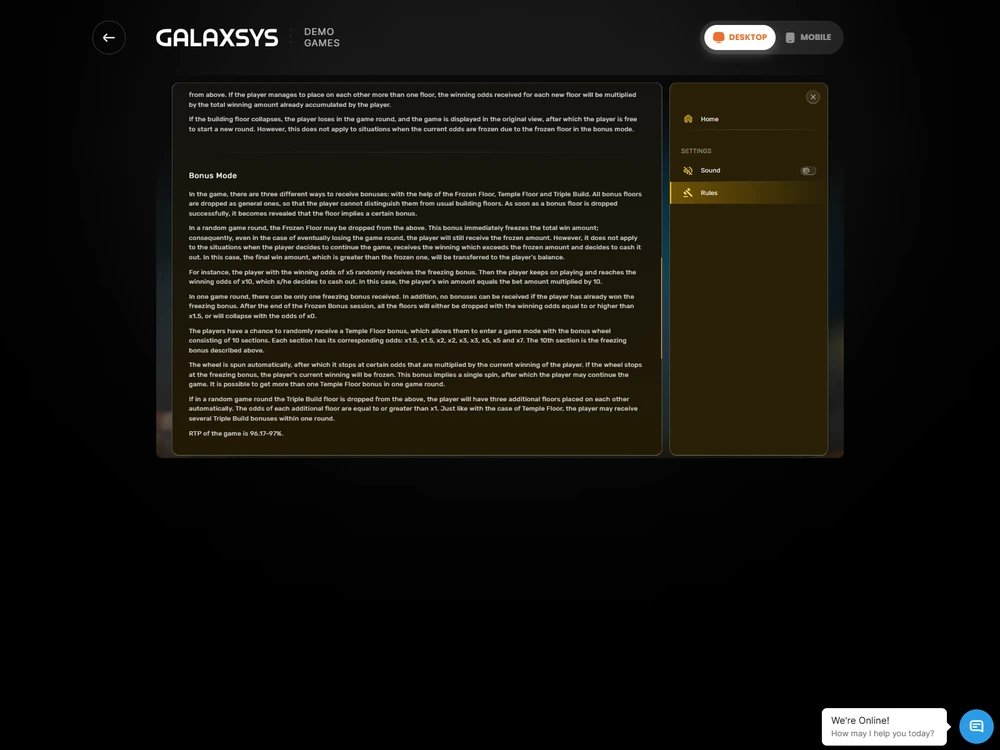
The sample contains four bonus events: Frozen Floor twice, Temple once and Triple Build once. Its largest gross payment is 68.75 FUN. Net results have sample variance of 421.548406 FUN² with 23 in the denominator, giving a 20.531644 FUN standard deviation. Drawdown reaches 61.50 FUN, and the longest sequence without a gross payment lasts three rounds.
For rounds with a positive gross payment, the 95% Wilson interval is 59.5295%–90.7552%. That range expresses sampling uncertainty for the defined outcome; it neither estimates a new RTP configuration nor predicts the next session.
Bonus arithmetic must follow the mechanic. Temple applied 2× to an accumulated 1.8× amount on an 8.50 FUN stake, giving 30.60 FUN gross; Triple Build applied 1.2 × 1.25 × 2 to one 16.00 FUN debit, giving 48.00 FUN rather than three charged stakes.
The continued Frozen Floor example starts from 11.00 FUN, protects 27.50 FUN and ends with 68.75 FUN gross, including that protection. Subtracting the stake gives 57.75 FUN net. The 41.25 FUN above protection measures the increase during continued play rather than another credit of the frozen amount.
Cash, bonuses and external payments
Cash-play records keep deposits and withdrawals apart from welcome credits: each of the ten selected operator episodes starts at zero, uses one deposit and eight cash bets whose total turnover equals that deposit, then records one external withdrawal and the remaining account balance.
A charge inside a withdrawal request reduces the received payment without adding another account debit. In the MyStake example, 3,656.25 PKR was requested and 10.97 PKR deducted at 0.30%, leaving 3,645.28 PKR received. The account debit remains 3,656.25 PKR. Adding the fee again would break the reconciliation.
Payment timing distinguishes the operator's processing stage from the external transfer stage, while deposit and withdrawal availability stay attached to their particular method, currency and route; a method displayed in a cashier is a different observation from an executed payment through it.
Crypto records retain the asset and network alongside transaction amounts. The separate Stake crypto episode is not merged into its PKR/UPaisa cash sequence. A currency conversion also needs its own rate and direction, rather than a nominal relabelling of one amount as another currency.
Welcome corrections are counted once in the bonus record. At 4RABET, an initially missing 5,875.00 PKR credit was fully added. At Betclic, 1,312.50 PKR was added to the initial 1,312.50 PKR to complete a 2,625.00 PKR entitlement. Neither adjustment increases the cash-play result.
For each selected welcome offer, the game's contribution is 0%. Correct issuance and eligible wagering must therefore be checked separately: successfully crediting a bonus does not make that offer useful for wagering on Tower Rush.
Support also has separate endpoints. An automated greeting is recorded first. The substantive answer is timed from the submitted question, and closure records completion of the enquiry. Financial correction uses the actual credit event; it is not inferred from a friendly response or a closed chat.
The substantive-answer range across the ten clarification cases was 27–324 seconds; those measured intervals and the distinct bonus-fix clocks belong to the support outcomes, without becoming a universal service guarantee or evidence of an external dispute procedure being tested.
Arithmetic checks and cryptographic checks
Arithmetic reconciliation checks that the stake, multipliers, payout and balance agree, whereas a cryptographic check follows the applicable game version's commitment, seeds, input order, nonce and result conversion; proving that a balance adds up does not substitute for the latter process.
The fairness explanation treats the round's cryptographic verification separately. Neither a losing outcome nor a delayed animation establishes failure of the cryptographic check; the accepted server event, visible state and verification method each need their own interpretation.
Recovery follows the original event identifier and credits its settlement once. A disconnect before acceptance produced no debit in my interruption test. After acceptance, reconnecting retrieved the same round with no duplicate payment. A pending result remains pending until settlement; a changed stake applies to the next round, and a limit restricting the next bet does not cancel an already accepted round's settlement.
What a simulation can and cannot establish
A simulation describes the model entered into it, so the two-policy calculation uses an independent two-outcome model rather than claiming to reconstruct Tower Rush's floor probabilities: each accepted stake returns 2× gross with probability 0.485 or zero with probability 0.515, giving 97% expected RTP.
I calculated 24,000 runs for each policy. Each starts with 6,600.00 PKR and a 50.00 PKR base stake, with a maximum of 90 cycles, net boundaries of ±1,800.00 PKR checked after settlement, and a 36,000.00 PKR stake cap. An unaffordable next stake stops before any debit.
The fixed-stake model averaged −136.86 PKR net on 4,499.88 PKR turnover, compared with −270.43 PKR on 8,861.71 PKR for doubling after a loss. The difference in turnover matters: comparing losses alone would hide the change in exposure.
The fixed-stake distribution has a 5th percentile of −900.00 PKR, median of −100.00 PKR and 95th percentile of 600.00 PKR; the doubling equivalents are −3,150.00, 1,800.00 and 1,800.00 PKR. These quantiles use linear interpolation at position (N − 1)p.
The fixed policy stopped at the cycle limit in 23,989 runs, the loss boundary in ten and the profit boundary in one. Doubling reached the profit boundary in 13,018 runs, the loss boundary in 10,890 and the cycle limit in 92. Checking limits after settlement allows a result to cross beyond a boundary.
Here, ruin means a remaining balance below 27.00 PKR, not any stop-loss event: neither policy recorded ruin in its 24,000 runs, but zero observations still have a one-sided 95% upper probability bound of 0.012481%, rather than establishing zero risk.
For a matched 35,000.00 PKR turnover, 97% RTP implies 33,950.00 PKR expected gross return and 1,050.00 PKR expected loss. At 96.2%, expected loss is 1,330.00 PKR. The RTP difference is 0.8 percentage points. The 280.00 PKR loss reduction is about 21.05% relative to 1,330.00 PKR.
These are expectation calculations, not session promises or a way to recover losses; the RTP guide explains why comparing an identical turnover is necessary before drawing conclusions about the cost of play under different configurations.
What the ten-point scale means
The scale translates evidence into a judgement about the task being assessed, with the criterion's weight expressing importance and its calibration expressing performance; a large weight cannot turn an unsupported observation into a strong score.
| Band | Meaning | Evidence interpretation |
|---|---|---|
| 0–2 | Critical failure or severe weakness | A confirmed failure is different from an unknown result |
| 3–4 | Weak | Materially below the applicable comparison basis |
| 5–6 | Functional with limitations | The core task works with meaningful friction |
| 7–8 | Strong | Above-average performance without a major user-value failure |
| 9–10 | Exceptional | Strong results supported across the relevant checks |
Match the criterion to the right comparison
Calibration follows the user benefit: lower fees reduce payment burden, and shorter measured waits support a speed judgement. Stability instead requires repeated completion under defined conditions, while navigation and control clarity concern the ease of carrying out the task.
Transparency concerns whether terms and calculations can be followed; availability concerns whether the relevant user can access the feature; support quality combines accuracy, helpfulness and resolution rather than rewarding an automatic reply simply because it arrived quickly.
Breadth compares the relevant set of options, value compares like-for-like costs and benefits, and safeguards concern the applicable protections and controls. When a criterion fits two families, its stated purpose determines the comparison. The operator reference set here contains ten profiles. It is not a market-wide percentile ranking.
Product comparisons likewise identify the actual titles before counting them: the comparison roster contains 15 distinct games, eight from the studio and seven external titles, with aliases deduplicated rather than counted as additional products or treated as proof of quality.
Apply bands without changing the published model
The general calibration system uses half-point criterion steps, selecting the lower part of a band for mixed or narrowly sufficient performance and the upper part for consistently strong performance; moving to a higher band requires evidence for that stronger description.
The specific Tower Rush and operator models retain their measured decimal criterion inputs and publish final results to two decimal places. Applying the general half-point grid retroactively would change those models, so intermediate values remain intact.
The game scoring model
Tower Rush scores 7.31/10 for the usability of the assessed profile, calculated from five criteria whose weights sum to 100%; the number does not represent return to player, the probability of a win or a forecast of profit.
| Criterion | Weight, % | Score out of 10 | Weighted contribution |
|---|---|---|---|
| Rule clarity | 30 | 7.8 | 2.340 |
| Controls | 20 | 8.4 | 1.680 |
| Modes | 15 | 7.5 | 1.125 |
| Stability | 20 | 5.8 | 1.160 |
| Settlement verifiability | 15 | 6.7 | 1.005 |
Multiply each criterion by its weight as a fraction, then add the contributions: 2.340 + 1.680 + 1.125 + 1.160 + 1.005 = 7.310. All five criteria are included. The final result is 7.31/10 using half-up rounding to two decimal places. Intermediate contributions are retained for the calculation.
The operator scoring model
Operator scores use six categories because account payments, promotions and support belong to the operator experience rather than to the game itself; the same category weights apply across the ten assessed profiles so that the comparison retains one definition of overall performance.
| Category | Weight, % | Evidence considered |
|---|---|---|
| Payments | 25 | Separate deposits, withdrawals and deductions |
| Bonuses | 20 | Welcome-credit formula and the game's wagering contribution |
| Games | 20 | Correct title identity and the mode actually available |
| Mobile | 15 | Four launch series with the same timing endpoints |
| Support | 10 | Substantive response, explanation and resolution |
| Transparency | 10 | Clear separation of own cash and bonus funds |
The calculation is 0.25 × Payments + 0.20 × Bonuses + 0.20 × Games + 0.15 × Mobile + 0.10 × Support + 0.10 × Transparency, with all six categories represented for each profile and the final published totals retained to two decimal places.
Betify illustrates why a rating cannot replace an eligibility check: its individual cash episode was successful, while its terms prohibit Pakistani residents from registering new accounts. Both the result and the territorial condition remain attached to the comparison.
Missing information, applicability and updates
An unknown value is not scored as zero: a zero requires a confirmed result supporting it, while a verified absence can legitimately affect a criterion when the missing feature matters to that criterion's purpose, such as whether a required control is available.
An inapplicable criterion concerns a feature or task outside the assessment's scope. An unknown result concerns an applicable criterion whose outcome has not been established; neither is a confirmed failure. A comparison benchmark is distinct from an observed transaction or measured launch.
Game configuration, payment method, account conditions and geography stay attached to their facts: a Pakistan account result does not establish worldwide service, and a deposit route does not establish withdrawal availability. A changed rule, feature, measurement or access condition can require the relevant assessment to be updated.
A corrected fact is traced into every calculation and comparison that uses it, including each language version. Paid placement receives its own label. A rating cannot be purchased. Affiliate links carry nearby disclosures, and their commercial purpose has no role in the arithmetic of a score.
Only an evaluative game or operator assessment receives the applicable score; this methodology and the complaints guide have no separate rating, and a correction request should identify the statement and page that need attention so its dependent uses can be checked together.
Tower Rush testing methods and rating criteria
Frequently asked questions
Why does a short Tower Rush session return differ from RTP?
For the 24 settled demo rounds, dividing 652.00 FUN in payouts by 363.00 FUN of comparable stakes gives 179.614325%. That is a session result. The configured 97% RTP describes theoretical return, without requiring every short session to reproduce that percentage.
Is the Tower Rush score a prediction of profit?
No. The 7.31/10 score combines rule clarity, controls, modes, stability and settlement verifiability for the assessed profile. It evaluates the experience of using the game, not the chance of making money.
Do the launch tests include deliberate connection failures?
No. The 280 ordinary launches comprise four seven-attempt series across ten operator profiles. Deliberate network interruptions and desktop checks are separate, so they do not change that ordinary-launch denominator.

Abid Bilawal
Author: Abid Bilawal
Role: iGaming, betting and gambling expert
Experience: 10+ years analysing online casinos, game providers, games and payment systems
Published: November 6, 2026
Device: Google Pixel 10a / Android 16 / Pixel UI
Additional device: iPhone 16 / iOS 26.5
Methodology: Methodology
Publisher and licensing
Tower Rush Pakistan is an informational publisher about the original Tower Rush by Galaxsys. The publisher does not accept bets, hold operator funds, create casino accounts or promise returns. The game provider, casino operators and publisher are separate entities. Third-party trademarks belong to their respective owners.
Responsible gambling
Play responsibly. Gambling involves financial and personal risks. Set your limits. Need help? Contact GamCare or visit GambleAware. 18+.